

 Web Gis

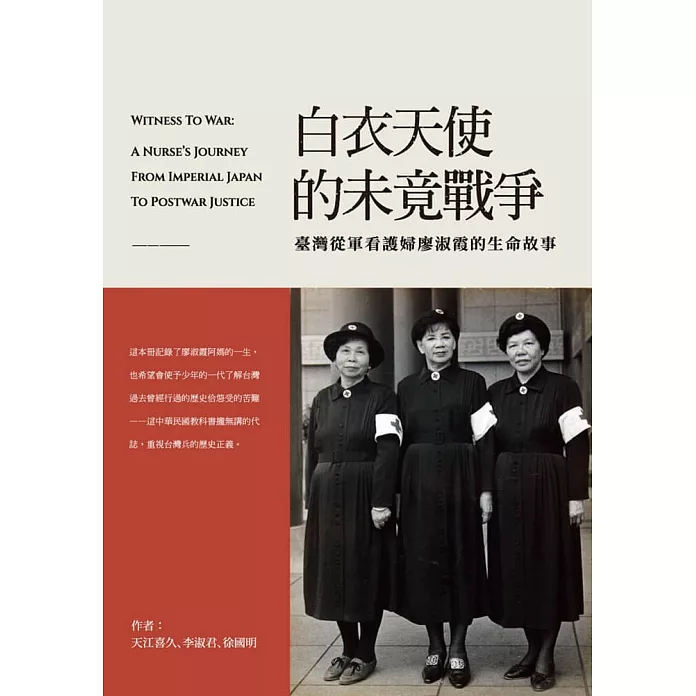
漢學研究中心2023年度獎助訪問學人天江喜久教授合著之新書發表
標題:
漢學研究中心2023年度獎助訪問學人天江喜久教授合著之新書發表
內容簡介:
漢學研究中心2023年度獎助訪問學人天江喜久(Yoshihisa Amae,夏威夷大學馬諾分校政治學系博士)合著《白衣天使的未竟戰爭:臺灣從軍看護婦廖淑霞的生命故事》於今年4月由蒼璧出版公司出版。
系統號:
CCS-102017

本館與美國華盛頓大學邀請林玉茹教授擔任臺灣漢學講座主講
標題:
內容簡介:
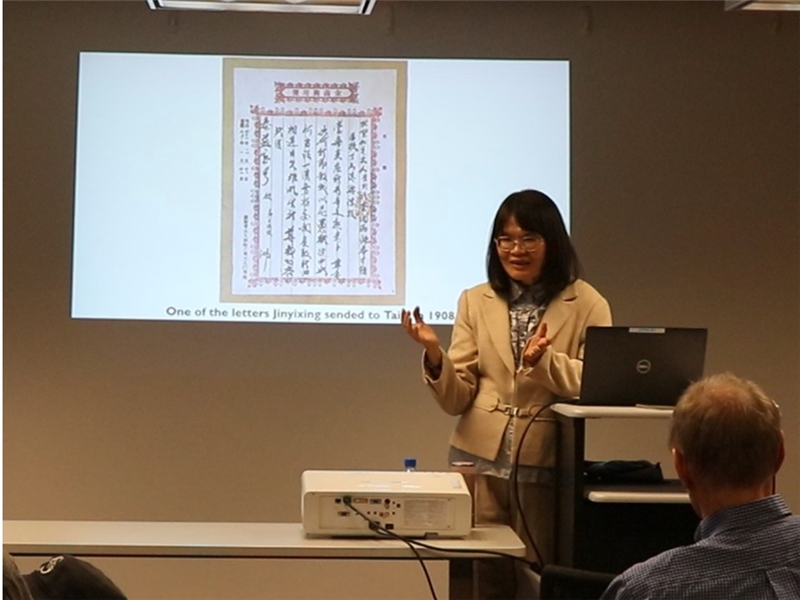
國家圖書館2026年首場「臺灣漢學講座」於美國西雅圖當地時間4月1日下午3時30分,在臺灣漢學資源中心合作夥伴單位美國華盛頓大學(University of Washington)「舘內東亞圖書館」 (UW Tateuchi East Asia Library)舉行。本次活動由雙方共同策劃辦理,特別邀請中央研究院臺灣史研究所研究員林玉茹博士擔任主講,講題為「帝國夾縫間的商業韌性:南臺灣大海產商的出現(1894-1941)」(Commercial Resilience between the Cracks of Empires: A Leading Seafood Merchant in Southern Taiwan)。活動並由該館中文研究館員李哲嘉女士(Lucy Li)擔任引言。
林玉茹博士長期深耕臺灣商業史、社會經濟史、清代臺灣史、區域研究及臺灣海洋史等領域,學術造詣深厚,曾獲國科會傑出研究獎肯定,並先後赴美國哈佛大學、哥倫比亞大學及日本東京大學等國際頂尖學府擔任訪問學者。其代表專著包括《清代竹塹地區的在地商人及其活動網絡》、《國策會社與殖民地邊區的改造》等,長期致力於推動臺灣史研究的國際化與學術交流。
本次講座聚焦於出身公務員家庭的王汝禎(1880-1953)及其一手創辦的「金義興商號」。林博士深入淺出地探討王汝禎如何在清朝過渡至日本殖民統治的政權交替期,從相對弱勢的社會地位突圍,成功建立龐大的貿易版圖並實現階級的向上流動。為還原歷史面貌,林博士廣泛徵引長崎泰益號文書、戶籍資料、當時報刊、自傳及旅行證件等珍貴的一手史料,精闢分析金義興商號在面臨中日帝國權力更迭與全球經濟變動的雙重夾擊下,其營運策略的發展軌跡。
此外,演講中也細緻剖析了王汝禎的商人身分轉變,以及他如何順應時代潮流,積極學習現代商業實務以適應新體制。王汝禎的生平不僅是一部個人奮鬥史,更充分展現了當時臺灣商人在殖民統治與帝國夾縫中所淬鍊出的強大商業韌性。
本次講座迴響熱烈,不僅為華大師生帶來了豐富的歷史視角,主講人林玉茹研究員並於活動前後與該校漢學研究領域如Matthew Mosca (馬世嘉) 教授,以及臺灣研究、東亞研究領域學者及圖書館員進行交流,更進一步深化了國際學界對臺灣社會經濟史的認識與理解。
照片說明:中央研究院臺灣史研究所研究員林玉茹博士主講
系統號:
CCS-102024
寰宇漢學講座邀請喬耐斯博士演講
標題:
時間:
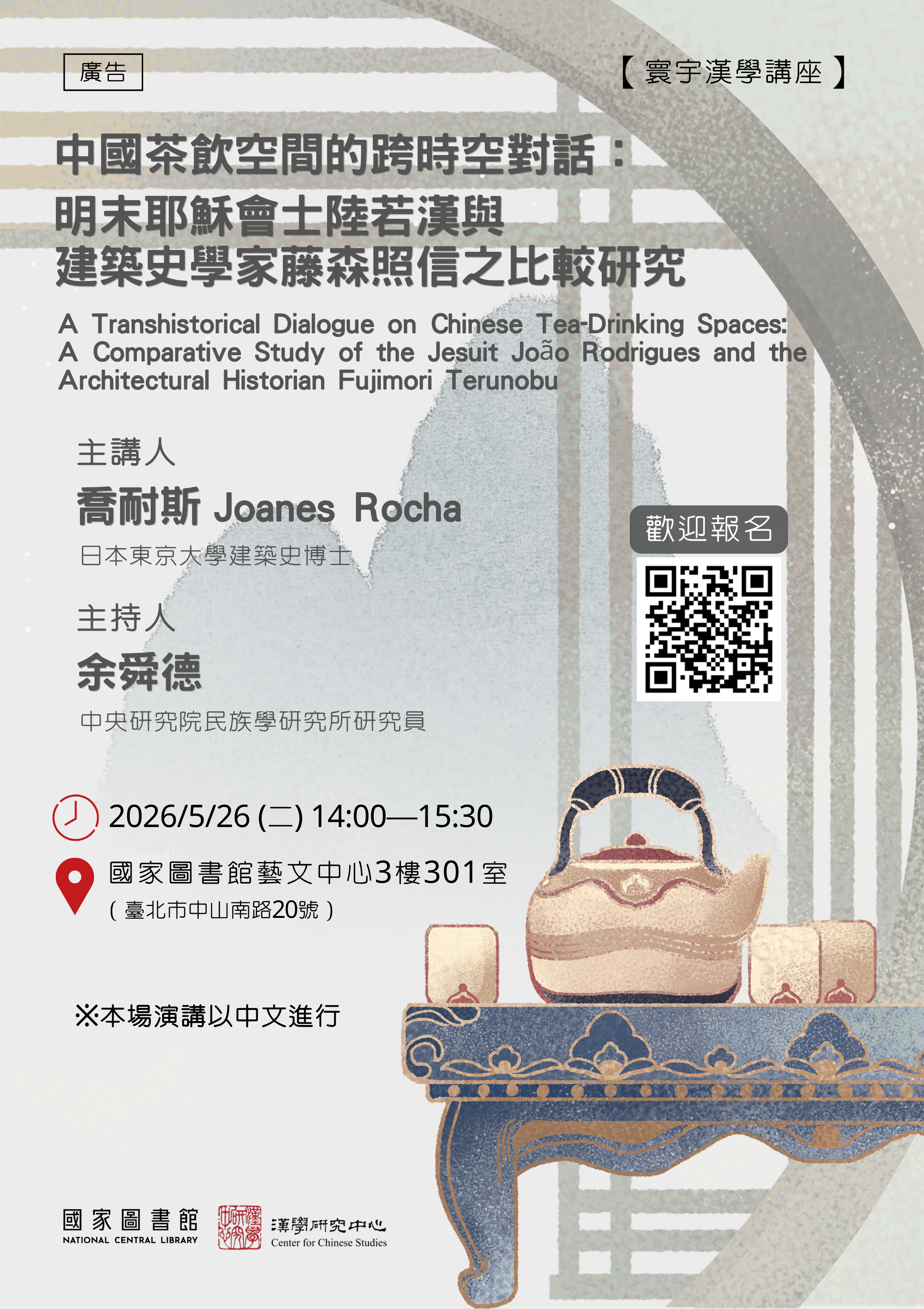
2026年5月26日(週二)14:00-15:30
主講人:
喬耐斯(Joanes Rocha,日本東京大學建築史博士)
地點:
國家圖書館藝文中心3樓301室(臺北市中山南路20號)
主辦單位:
國家圖書館、漢學研究中心
內容簡介:
講者:喬耐斯(Joanes Rocha,日本東京大學建築史博士)
講題:中國茶飲空間的跨時空對話:明末耶穌會士陸若漢與建築史學家藤森照信之比較研究(A Transhistorical Dialogue on Chinese Tea-Drinking Spaces: A Comparative Study of the Jesuit João Rodrigues and the Architectural Historian Fujimori Terunobu)
主持人:余舜德(中央研究院民族學研究所研究員)
演講摘要:
在其著作《藤森照信的茶室學:日本的極小空間之謎》中,建築史學家藤森照信不僅系統性地梳理了日本茶室的歷史發展脈絡,還以建築史研究為基礎,對中日茶文化及飲茶空間的差異進行了比較分析。本報告指出,藤森照信的若干核心觀點,尤其是關於中國未形成專門用於飲茶的獨立建築空間這一判斷,早在四個世紀之前便已由耶穌會士陸若漢(Joao Rodrigues)在其所著的葡文《日本教會史》(1622年)中提出。值得注意的是,儘管兩位作者相隔四百餘年,他們兩位均以日本草庵式茶室作為理解中國茶文化的重要參照框架,並由此審視中國的飲茶實踐及其空間形態。
在此基礎上,本報告亦將進一步從建築空間的角度展開分析,探討中日之間不同茶類(如點茶與泡茶)及其製作方式的差異在空間使用上的體現,例如圍繞桌面展開的飲茶形式和於榻榻米席地而坐之差異,如何影響日本茶室和露地(日式庭園)的形成,並與明末清初以來茶館以及近現代茶藝館的發展相互對照。透過結合明代耶穌會文獻與現代建築史研究,本報告認為,此一比較不僅揭示了建築類型與社會實踐之間長時段的互動關係,亦有助於深化我們對中國茶飲空間邏輯的歷史性理解。
In his book Fujimori Terunobu’s Theory of the Teahouse: The Mystery of Japan’s Minimal Space, the architectural historian Fujimori not only offers a systematic account of the historical development of the Japanese teahouse, but also, grounded in architectural-historical analysis, presents a comparative analysis of tea culture and tea-drinking spaces in China and Japan. This presentation argues that several of Fujimori’s central claims, in particular the assertion that China did not develop a specialised and independent architectural space dedicated exclusively to tea consumption, had already been articulated more than four centuries earlier by the Jesuit João Rodrigues in his Portuguese work History of the Church in Japan (1622).
Notably, despite the chronological distance separating these two authors, both employ the Japanese grass-hut, known as the sōan teahouse, as a conceptual framework for interpreting Chinese tea culture, thereby using the Japanese model as a lens to examine Chinese tea practices and their spatial configurations. Building on this comparison, the present study further develops an architectural analysis of the relationships among tea types, preparation methods, and spatial use in China and Japan. In particular, it examines how differences between powdered tea and infused tea, as well as the contrasting bodily practices associated with table-based consumption versus tatami-seated arrangements, are reflected in spatial organisation. These developments are then contrasted with the chaguan of the late Ming and early Qing periods, as well as with the evolution of modern chayiguan.
By integrating late Ming Jesuit sources with modern architectural historiography, this presentation contends that such a comparative approach not only reveals the longue durée interaction between architectural typologies and social practices but also contributes to a deeper historical understanding of the spatial logic underlying Chinese tea culture.
備註:本場演講以中文進行
※以上會議時間如有變動,本中心將依報名資料另行通知
系統號:
CCS-102032
寰宇漢學講座邀請蘇文彬先生演講
標題:
時間:
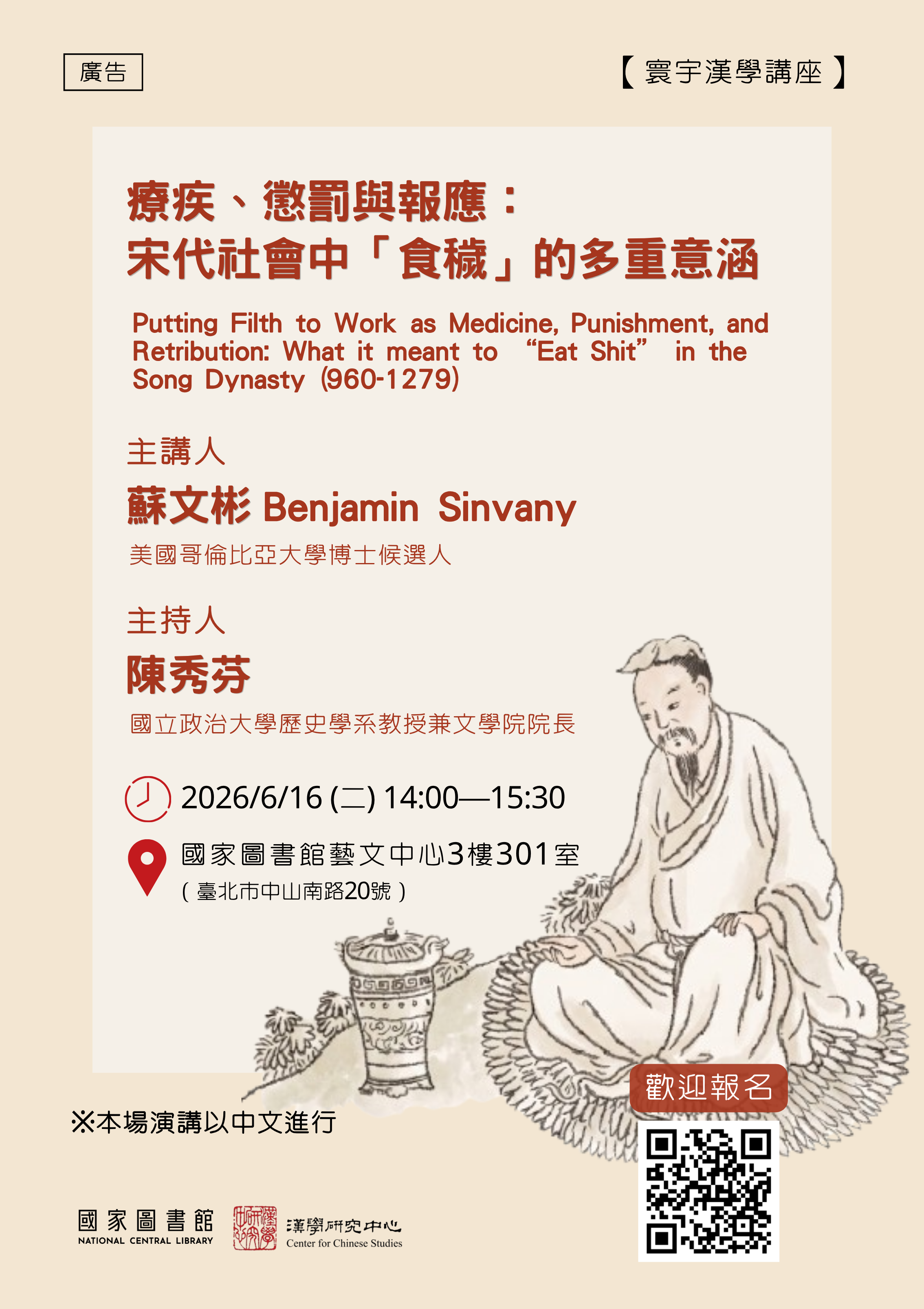
2026年6月16日(週二)14:00-15:30
主講人:
蘇文彬(Benjamin Sinvany,美國哥倫比亞大學歷史系博士候選人)
地點:
國家圖書館藝文中心3樓301室(臺北市中山南路20號)
主辦單位:
國家圖書館、漢學研究中心
內容簡介:
講題:療疾、懲罰與報應:宋代社會中「食穢」的多重意涵(Putting Filth to Work as Medicine, Punishment, and Retribution: What it meant to “Eat Shit” in the Song Dynasty (960-1279))
主持人:陳秀芬(國立政治大學歷史學系教授兼文學院院長)
演講摘要:
This talk is about the consumption of filth in the Song dynasty. Sometimes referred to as “eating shit” (食糞) or “eating filth” (食穢) this talk presents accounts of people literally eating feces. It uses a wide selection of Song sources including biji, records of the strange 志怪, medical prescription texts, as well as historical anecdotes preserved in leishu 類書. Taken together, these excerpts form a diverse mosaic of extreme behaviors. In some cases, people demand to eat feces, in others they are forced to consume it against their will, and in others it is administered as a known antidote to poisoning. There appear to be at least three different reasons people consumed human excrement in Song China: coercion, divine retribution, and medicine. The cases presented here reveal a logic of purity in the Song that allowed eating filth to function as a method for healing (an antidote to poison), a coercive punishment, and a symptom of divine retribution.
備註:本場演講以中文進行
※以上會議時間如有變動,本中心將依報名資料另行通知
系統號:
CCS-102192
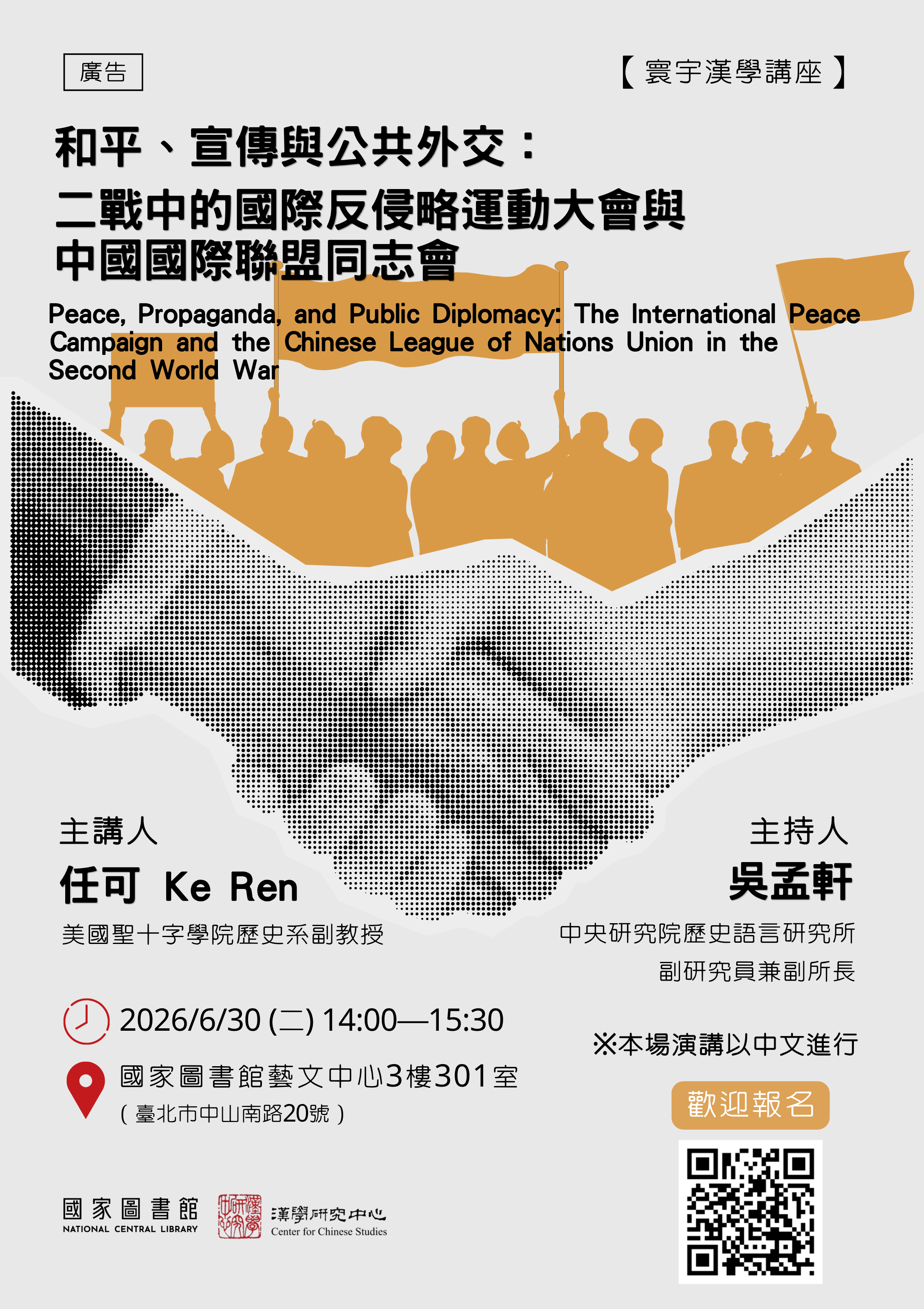
寰宇漢學講座邀請任可教授演講
標題:
時間:
2026年6月30日(週二)14:00-15:30
主講人:
任可(Ke Ren,美國聖十字學院歷史系副教授)
地點:
國家圖書館藝文中心3樓301室(臺北市中山南路20號)
主辦單位:
國家圖書館、漢學研究中心
內容簡介:
講題:和平、宣傳與公共外交:二戰中的國際反侵略運動大會與中國國際聯盟同志會(Peace, Propaganda, and Public Diplomacy: The International Peace Campaign and the Chinese League of Nations Union in the Second World War)
主持人:吳孟軒(中央研究院歷史語言研究所副研究員兼副所長)
演講摘要:
二戰在東亞的爆發和歐洲法西斯主義的興起,對中國和西方的國際主義者而言,既是危機也是挑戰。在1930年代至1940年代,中國和外國活動家致力於將中國納入各種跨國和平與反法西斯運動組織中。本次演講將聚焦於兩個重要的非政府或半官方組織:國際反侵略運動大會及其中國分會與中國國際聯盟同志會。這兩個組織都試圖將中國對日本侵略的抵抗置於捍衛世界和平與集體安全運動的核心。自1936年起,中國代表參加了多次由國際反侵略大會在歐洲主辦的國際和平會議,反侵略運動大會中國分會也發展為擁有十幾個省市分會和超過一百萬名會員的組織。而成立於第一次世界大戰末的中國國際聯盟同志會此時重組,成為國際主義和集體安全的主要倡導者,在中國國内宣傳國際聯盟,並通過發表雙語刊物、接待外國訪客以及積極參與國際活動,向國際社會闡釋東亞戰時政治局勢。
本次演講基於中國、臺灣、歐洲和美國的檔案資料,以及會議記錄和戰時書報期刊,探討二戰期間的國際反侵略運動大會及國際聯盟同志會怎樣在國家政府層面的互動之外,在中國國內宣傳國際主義並在國際舞台上為中國開展公共外交。這兩個組織的活動和出版物重新定義了和平與國際主義的意義,對二戰後的中國和臺灣也產生了一定的影響。
The outbreak of World War II in East Asia and the rise of fascism in Europe presented both a crisis and challenge to internationalists in China and the West. Throughout the 1930s-1940s, Chinese and international activists sought to incorporate China into a variety of transnational peace and anti-fascist movements or international organizations. This talk focuses on two key non-governmental or semi-official organizations – the International Peace Campaign (IPC) and its China national branch as well as the Chinese League of Nations Union (CLNU). Both groups sought to place China’s confrontation against Japanese aggression at the center of the movement to defend world peace and collective security. Beginning in 1936, Chinese delegates participated in several of the IPC- sponsored international peace conferences in Europe. At the same time, a National Branch of the IPC was established and eventually included over a dozen provincial and municipal committees and more than one million affiliate members. Simultaneously, the CLNU, originally established at the end of WWI, reorganized itself to become a leading advocate of liberal internationalism and collective security which promoted the League of Nations within China and elucidated political affairs in East Asia for an international audience through bilingual publications, hosting foreign visitors, and active participation in international societies.
Based on archival materials in China, Taiwan, Europe and the United States as well as conference proceedings and contemporary newspapers and periodicals, this talk argues that beyond state-level interactions, the IPC and the CLNU played an important role promoting internationalism in China while performing public diplomacy for China on the world stage during the Second World War. At the same time, their activities and publications reframed the meaning of peace and internationalism, with ramifications for both China and Taiwan in the post-WWII world.
備註:本場演講以中文進行
※以上會議時間如有變動,本中心將依報名資料另行通知
系統號:
CCS-102191
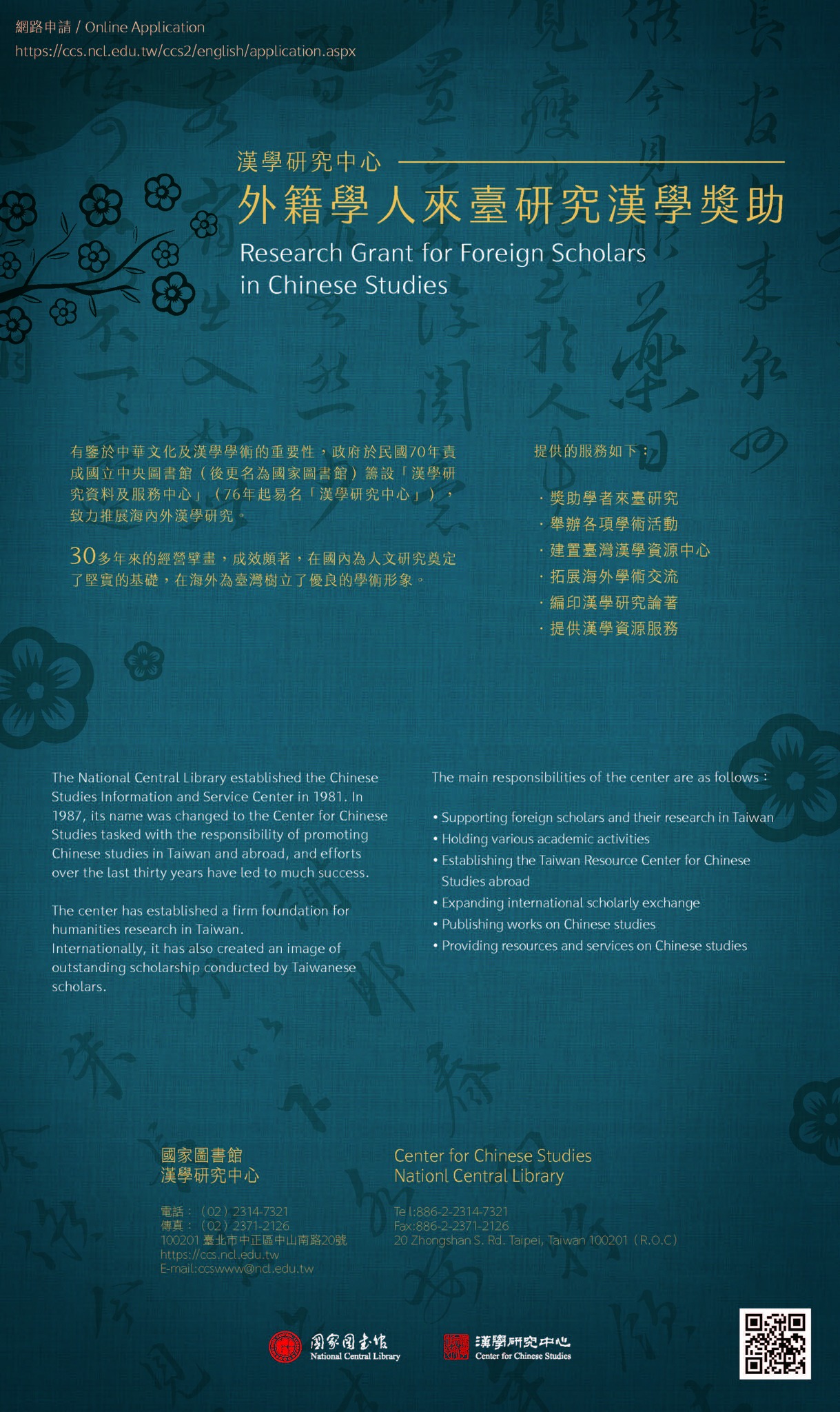
漢學研究中心2027年來臺外籍學人獎助申請公告
標題:
時間:
2026年5月31日、6月30日截止
地點:
國家圖書館(臺北市中正區中山南路20號)
內容簡介:
漢學研究中心負責管理兩項研究獎助計畫:「外籍學人來臺研究漢學獎助」及「外交部臺灣獎助金」。
「外籍學人來臺研究漢學獎助」2027年度的申請截止日期為2026年5月31日,所有申請資料皆須於此日期前以電子郵件或航空郵件寄達。甄選委員會的審查結果預計將於八月底前通知所有申請人。外交部委託本館漢學研究中心執行之「臺灣獎助金」2027年度申請期間為2026年5月1日至6月30日。
更多資訊及線上申請,請參閱以下網站:
外籍學人來臺研究漢學獎助: https://ccs.ncl.edu.tw/ccs2/ENGLISH/information.aspx
外交部臺灣獎助金: https://taiwanfellowship.ncl.edu.tw
符合資格的學者可同時申請兩項獎助金,若您對上述獎助計畫或漢學研究中心有任何疑問,歡迎與我們聯繫,電子郵件信箱為 ccsgrant@ncl.edu.tw 或 twfellowship@ncl.edu.tw
=============================================================================
Dear colleagues,
We are pleased to announce the call for applications for the 2027 Research Grant for Foreign Scholars in Chinese Studies (外籍學人來臺研究漢學獎助) administered by the Center for Chinese Studies (CCS, 漢學研究中心) at the National Central Library (NCL, 國家圖書館) in Taipei, Taiwan (R.O.C.). We would appreciate your assistance in disseminating this information.
The Center for Chinese Studies administers two research grants: the Research Grant for Foreign Scholars in Chinese Studies and the MOFA Taiwan Fellowship (外交部臺灣獎助金).
Applications for the 2027 Research Grant for Foreign Scholars in Chinese Studies are currently being accepted, with a deadline of May 31, 2026. All application materials for the Research Grant must be submitted electronically or by air mail no later than this date. Notification of the Selection Committee's decisions will be sent by the end of August. Applications for the 2027 Taiwan Fellowship, which CCS administers on behalf of the Ministry of Foreign Affairs, Taiwan (R.O.C.), will be accepted from May 1 to June 30, 2026.
Please visit our websites for more detailed information and online application:
Research Grant for Foreign Scholars in Chinese Studies: https://ccs.ncl.edu.tw/ccs2/ENGLISH/information.aspx
Taiwan Fellowship: https://taiwanfellowship.ncl.edu.tw
Scholars are encouraged to apply for both scholarships if eligible. Should you have any questions concerning either grant or the Center for Chinese Studies, please feel free to contact us via email at ccsgrant@ncl.edu.tw or twfellowship@ncl.edu.tw.
Sincerely yours,
Center for Chinese, Taiwan
National Central Library, Taiwan (R.O.C.)
系統號:
CCS-101989
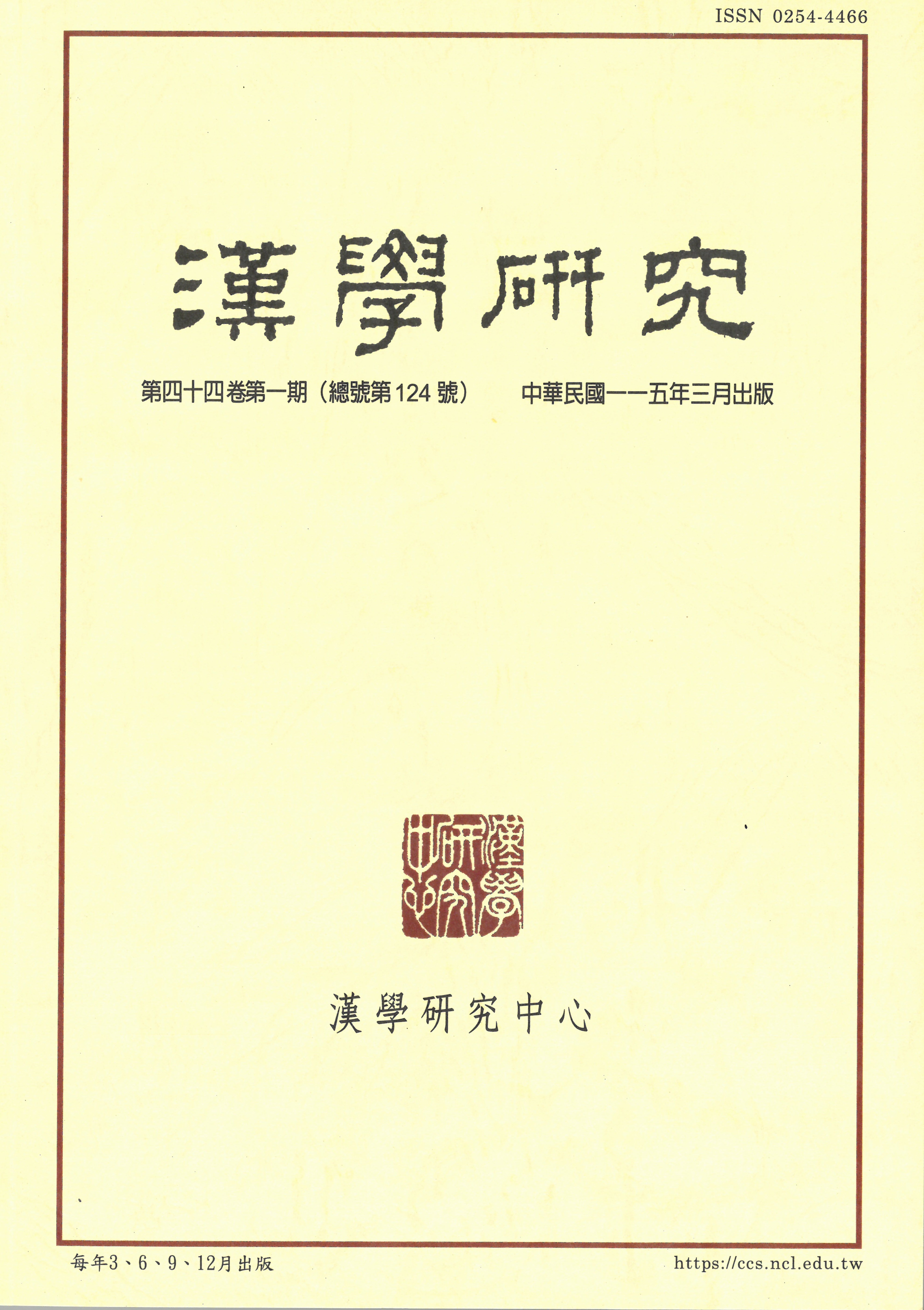
漢學研究第44卷第1期目次
標題:
漢學研究第44卷第1期目次
時間:
2026年3月
內容簡介:
漢初中尉考——以張家山336號墓〈功令〉為中心/馬增榮
兵屯與更番——1680年代的臺灣駐軍議論/李文良
《皇清職貢圖》所見清朝對回疆地區的認知與書寫/曲強
信眾語言與宗教地景——桃竹保生大帝、媽祖藥籤的閩客書寫及區域流播/陳筱琪
論虛詞反義同詞現象的形成——以「除」與「除非」為例探討/張麗麗
書評
評 武致知(Rens Krijgsman),《《清華大學藏戰國竹簡》研究與英譯6:《鄭武夫人規孺子》諸篇》/蔡瑩瑩
評 Ariel Fox 樊艾睿, The Cornucopian Stage: Performing Commerce in Early Modern China (戲裡錢坤:近世中國的戲劇商業)/ Sheng Yihui(盛亦惠)
系統號:
CCS-102051
