

 Web Gis

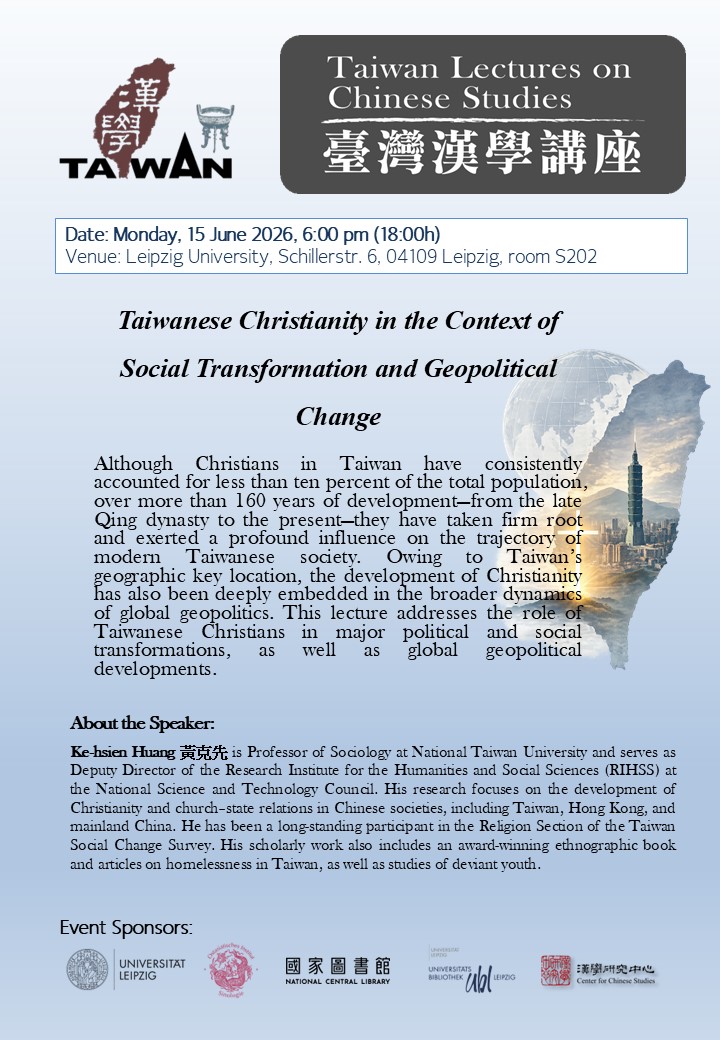
國圖與德國萊比錫大學合作辦理「臺灣漢學講座」
標題:
內容簡介:
國家圖書館今(2026)年度「臺灣漢學講座」(Taiwan Lectures on Chinese Studies)第2場將與德國萊比錫大學(Leipzig University)合作,邀請國立臺灣大學社會學系黃克先教授於當地時間6月15日(星期一)18時舉行實體講座。
講座資訊如下:
日期:德國時間2026年6月15日星期一18時(GMT+2)
講題:Taiwanese Christianity in the Context of Social Transformation and Geopolitical Change 社會轉型與地緣政治變遷下的臺灣基督宗教
講者:黃克先博士(國立臺灣大學社會學系教授)
地點:德國萊比錫大學歷史、藝術與區域研究學院大樓演講廳S102(Schillerstr. 6, 04109 Leipzig, Germany)
本場講座全程以英文進行。演講摘要請參見附檔。
本館承辦單位及聯絡人:漢學研究中心學術交流組 吳小姐(分機353)
系統號:
CCS-102211

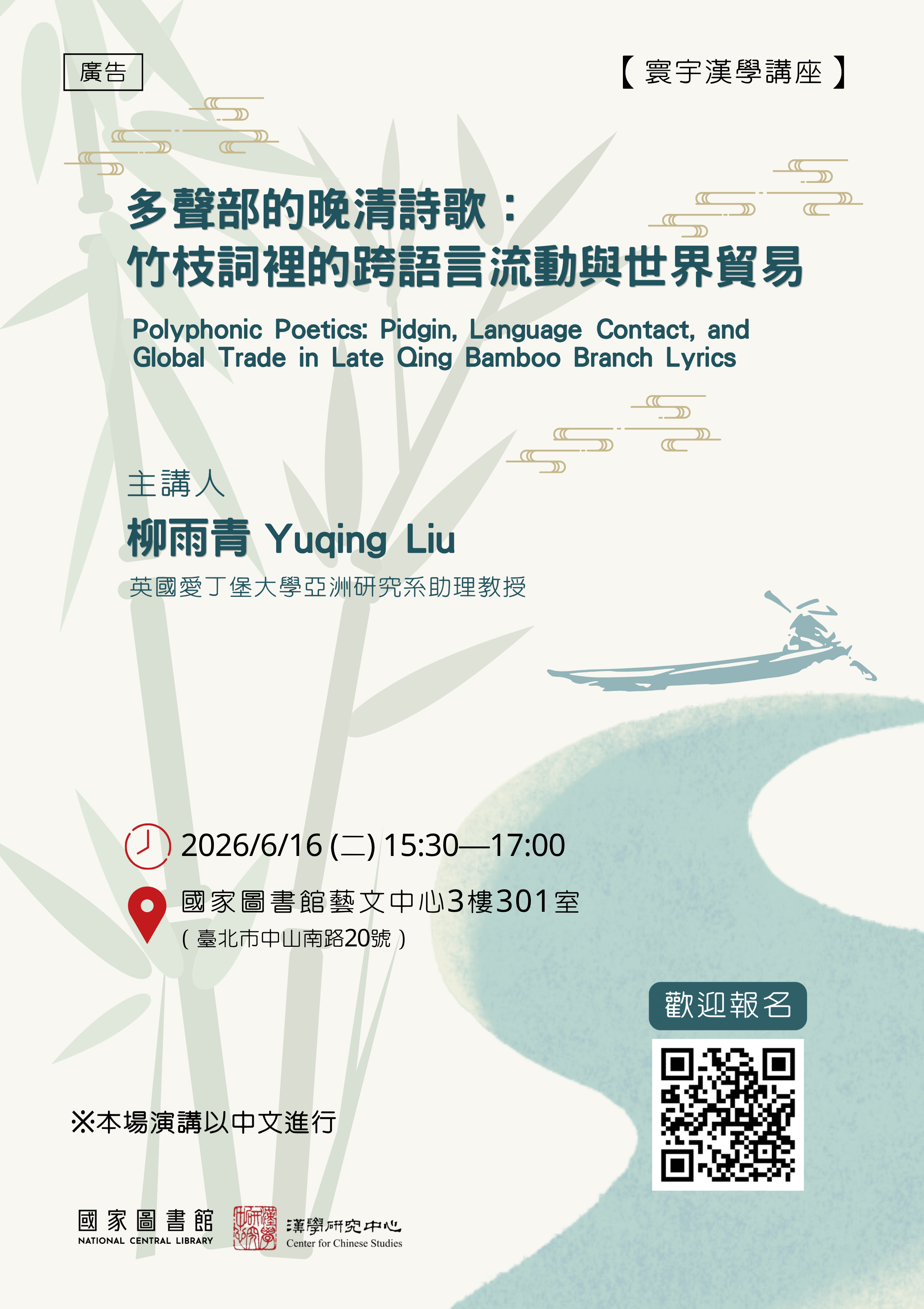
寰宇漢學講座邀請柳雨青教授演講
標題:
時間:
2026年6月16日(週二)15:30-17:00
主講人:
柳雨青(Yuqing Liu,英國愛丁堡大學亞洲研究系助理教授)
地點:
國家圖書館藝文中心3樓301室(臺北市中山南路20號)
主辦單位:
國家圖書館、漢學研究中心
內容簡介:
講者:柳雨青(Yuqing Liu,英國愛丁堡大學亞洲研究系助理教授)
講題:多聲部的晚清詩歌:竹枝詞裡的跨語言流動與世界貿易(Polyphonic Poetics: Pidgin, Language Contact, and Global Trade in Late Qing Bamboo Branch Lyrics)
主持人:待定
演講摘要:
皮欽語最早於18世紀出現在中國珠江三角洲一帶,是一種由英語、粵語、葡萄牙語、馬來語、官話、閩南語等各種中外語言混合而成的通用語。19世紀中葉,第一次鴉片戰爭後,大批粵籍商人與勞工相繼赴滬謀生,此一語言遂隨之擴散至長江三角洲地區。我的報告將追溯這一貿易語在廣州與上海的聲音再現,並以兩組詩歌為核心:潘有度約於1812年前後所作《西洋雜詠》,及1873年刊載於《申報》之《別琴竹枝詞》。藉助漢字形、音、義的創新排列組合,詩中皮欽詞語與表達形式構建出多層次的意義結構,同時調動漢字之語義、視覺與語音諸維度。皮欽語的引入因此開啟了廣闊的詮釋向度,使得各種讀法彼此並立而不相排斥。此外,有別於傳統竹枝詞將異域語言收編馴化的書寫慣例,這些詩歌呈現相反的聲音想象:皮欽語的介入使本土的、慣常的、熟悉的景觀與聲景陌生化。這些詩歌將貿易中心的廣東與上海呈現為眾聲喧嘩、語言駁雜的聲景空間,使異域感不再附著於域外他鄉,而是深度滲透於詩人自身的語言實踐與日常生活肌理之中。
Pidgin English first appeared in China along the Pearl River Delta as a lingua franca composed of a mixture of English, Cantonese, Portuguese, Hindi, and Malay as early as the 18th century. This language spread to the Yangtze River delta in the mid 19th century when an increasing number of Cantonese merchants and workers traveled to Shanghai to seek opportunities after the First Opium War. This talk traces the sounds of pidgin in Canton and Shanghai, cantering on two suites of poems: “Miscellaneous Songs of Western Ocean” penned by Pan Youdu around 1812 and “Pidgin Bamboo Branch Lyrics” published in the Shen Bao in 1873. Through analysis, I explore how pidgin was incorporated into classical Chinese poetry and how it consequently reflected and shaped the literary soundscape of nineteenth century the trading centres in China. I argue that pidgin English created a polyphonic space wherein Sinographs and European words, literary language and local tongues, and classical images and contemporary anecdotes intertwine to generate diverse and contradictory meanings. Through an innovative collocation of the sinographic, literal, and phonetic features of Chinese characters, the pidgin words and expressions craft in these poems a multilayered structure of meanings based on the semantic, visual, and phonetic values of the sinographs. The usage of pidgin, therefore, opens up a wide array of interpretative possibilities, each providing a unique lens through which to read the work. Moreover, unlike traditional bamboo branch lyrics in which foreign words are transcribed and incorporated to domesticate strangeness and consolidate the imperial order, these pidgin poems have an inverse effect: their use of pidgin English alienates the native, the conventional, and the familiar landscape/soundscape. This poetry depicts Shanghai as a cacophonous soundscape awash with a mishmash of languages and voices, making foreignness appear not in a foreign land, but in one’s own poetic language and everyday life.
主講人簡介:
柳雨青現任英國愛丁堡大學亞洲研究系專任助理教授,目前為國家圖書館漢學研究中心獎助學人,台灣大學文學院訪問學者。研究領域為中國文學,主要關注文學中多語性、詞典編纂學、及中歐文化接觸史。其研究項目曾獲英國學術院、美國學術團體理事會、以及亞洲研究學會之學術研究資助。其正在撰寫專著系統考察皮欽語在中國和世界貿易與殖民網絡中的歷史源流,探討其自十八世紀至二十世紀初在中國與歐洲語言文學中的挪用與衍變。
Yuqing Liu is a lecturer in the Department of Asian Studies at the University of Edinburgh. She is currently a recipient of a research fellowship from the Centre for Chinese Studies at the National Central Library, and a Visiting Scholar in the College of Liberal Arts at National Taiwan University. She specialises in Chinese literature, with a focus on multilingual poetry, lexicography, and Sino-European contact. Her research has been awarded grants and fellowships from the British Academy, the American Council of Learned Societies, and the Association for Asian Studies. Her current book project examines the history of pidgin in China, as well as its appropriation and adaptation in Chinese and English literatures from the eighteenth to the early twentieth century.
備註:本場演講以中文進行
※以上會議時間如有變動,本中心將依報名資料另行通知
系統號:
CCS-102235
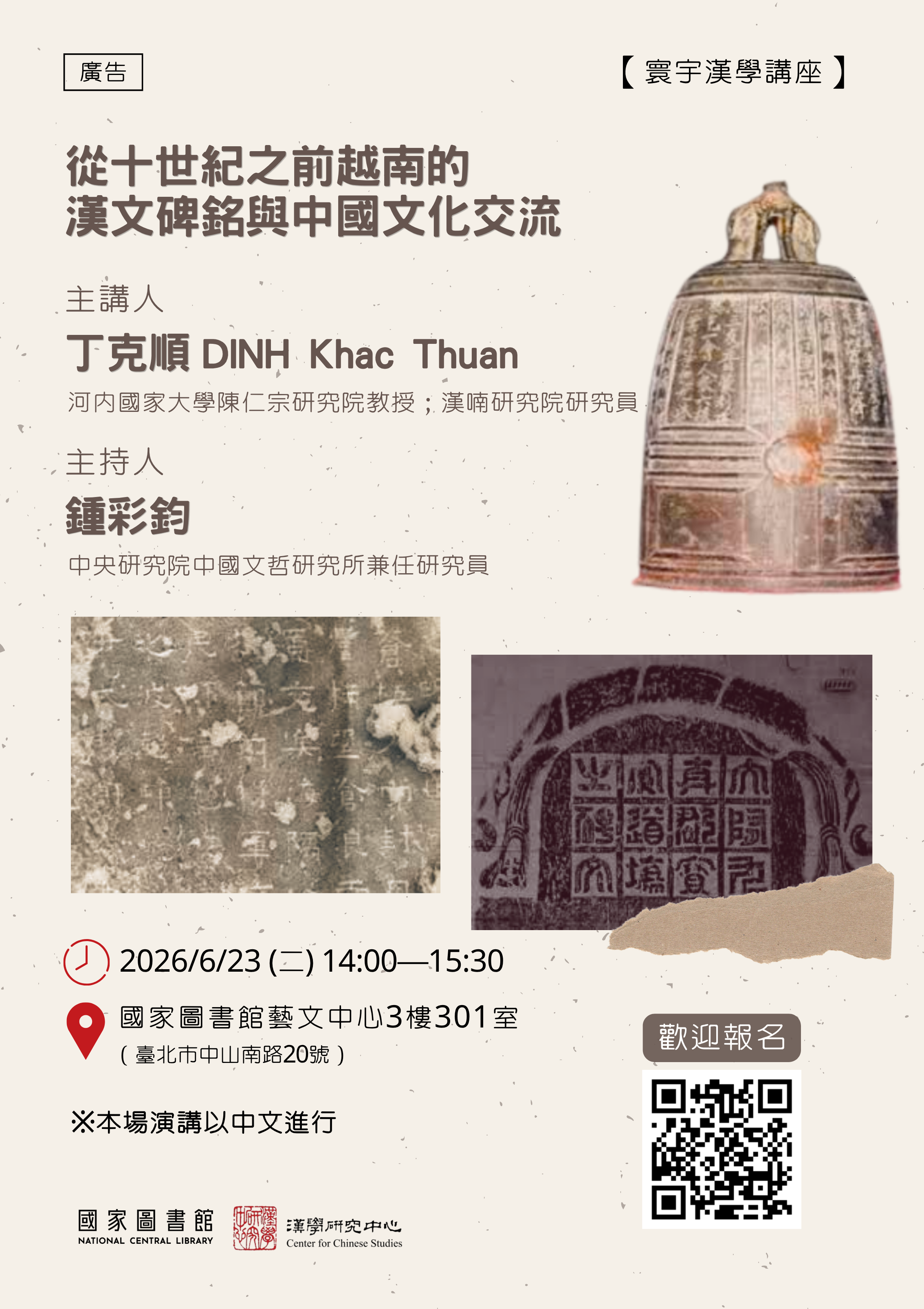
寰宇漢學講座邀請丁克順教授演講
標題:
時間:
2026年6月23日(週二)14:00-15:30
主講人:
丁克順(DINH Khac Thuan,河內國家大學陳仁宗研究院教授;漢喃研究院研究員)
地點:
國家圖書館藝文中心3樓301室(臺北市中山南路20號)
主辦單位:
國家圖書館、漢學研究中心
內容簡介:
講者:丁克順(DINH Khac Thuan,河內國家大學陳仁宗研究院教授;漢喃研究院研究員)
講題:從十世紀之前越南的漢文碑銘與中國文化交流
主持人:鍾彩鈞(中央研究院中國文哲研究所兼任研究員)
演講摘要:
中國漢字早在西元二世紀北屬時期已傳入越南。隨著漢字的進入,中國銘刻的習俗也在越南出現並越來越流行。早期越南的漢字銘刻與東亞世界有很強的關聯性,體現了與東亞區域的文字與文化交流。
在越南,從東山文化時期(公元前)東山鼓銅發現較多。其中兩種東山鼓銅上有最早期的漢字銘刻,即古螺鼓銅與富川鼓銅的漢字銘刻。此銘文不但是文字語言方面而且還是當時文化曆史的非常珍貴資料。這些文字在嶺南地區相互交流,包括越南北方,中部和今日靠近越南的中國南方一些省份。
北屬時期,在越南發現不少古墓磗、碑銘、銅鐘上的漢字銘文。這就是研究越南北屬時期非常重要的物質文獻,是漢字在越南流傳最具體的證據。
碑文、鐘文所提到的姓名,都是有具體的姓名籍貫北方人(青懷碑、長春古碑、禪衆舍利塔銘文、八世紀青梅銅鐘),之後逐漸出現越南人姓名(九世紀的日早銅鐘)。十世紀的碑文所紀錄的地名,如交州(今屬越南北部)、九真(今屬乂安)、日南(今屬清化)都屬於後來的越國。
禪衆舍利塔碑的龍編、日早銅鐘的慈廉地名,都幫我們確定交州中心是羸婁,今屬青薑社和北寧省順城縣附近,即發現禪衆四舍利塔碑和青懷碑之地,附近是龍編(包括河內東北地區)慈廉村,今龍編郡和慈廉郡。從丁、前黎時期(十世紀)的佛經可見在越南禪宗有密宗前期的色彩。另外,統治者要依靠宗教或佛教來提升神權的正統性。
主講人簡介:
丁克順教授(Prof. DINH Khac Thuan)為越南重要漢喃學、越南漢文文獻與碑刻研究學者,現為河內國家大學陳仁宗研究院教授、越南社會科學學院教授,並任漢喃研究院研究員。丁教授早年畢業於河內外語師範大學,後於漢喃研究院取得漢喃語文博士學位,並於法國社會科學學院取得歷史博士學位。
丁教授長期致力於越南漢文文獻、碑刻、鐘銘、科舉儒學與歷史文化研究,曾任《漢喃雜誌》副總編輯,並曾擔任世界漢字學會、越南漢字學會會長,在越南漢字文化與漢喃文獻研究領域具有深厚學術影響力。其研究成果豐富,近年發表〈科舉儒學在越南的傳播與發展〉、〈越南竹林佛教及其遺址碑文〉、〈越南李朝漢喃碑文的版本及其資料價〉等論文,並出版《越南從北屬時期至陳代的漢文碑刻》、《越南莫朝的漢文碑刻:研究與資料》、《黎初佛教碑刻》、《越南從北屬至李陳時期的漢字碑刻》等專書與資料整理成果。
丁教授此次以國家圖書館漢學研究中心2026年「外籍學人來臺研究漢學獎助」訪問學人身分來臺研究,本次演講將以十世紀之前越南漢文碑銘為中心,探討早期越南與中國之間的文化交流、文字傳播與歷史記憶,為理解東亞漢字文化圈與越南歷史文化發展提供重要視角。
備註:本場演講以中文進行
※以上會議時間如有變動,本中心將依報名資料另行通知
系統號:
CCS-102240
喬耐斯博士寰宇漢學講座報導
標題:
主辦單位:
漢學研究中心
內容簡介:
本館漢學研究中心於2026年5月26日下午舉辦「寰宇漢學講座」,邀請本中心2026年度漢學獎助學人、日本東京大學建築史博士喬耐斯(Joanes Rocha)擔任主講,講題為「中國茶飲空間的跨時空對話:明末耶穌會士陸若漢與建築史學家藤森照信之比較研究」。本場講座由中央研究院民族學研究所余舜德研究員主持。
喬耐斯博士現為國家圖書館漢學研究中心獎助學人,曾任中央研究院歷史語言研究所訪問學者,並曾於巴西利亞 UniCEUB 大學教授建築理論與歷史課程。其主要研究領域為16至19世紀葡萄牙人在東亞地區,特別是日本、中國大陸與澳門的活動,以及相關建築與文化遺產的保護與詮釋。他長期從建築史、文化史與東亞交流史的角度切入,關注跨文化接觸如何影響空間、禮儀與歷史書寫。
在本次講座中,喬耐斯博士以明末耶穌會士陸若漢(João Rodrigues)與現代日本建築史家藤森照信對中國茶文化與茶飲空間的觀察為核心,展開一場跨越四百餘年的比較研究。藤森照信在《藤森照信的茶室學:日本的極小空間之謎》中,曾以日本茶室為參照,討論中國茶文化未如日本一般發展出專門、獨立的茶室建築。喬耐斯博士指出,這一判斷其實早在17世紀初便已出現在陸若漢的葡文《日本教會史》中。儘管兩位作者所處時代相隔甚遠,卻同樣透過日本草庵式茶室與茶之湯的經驗,重新審視中國飲茶實踐及其空間形態。
喬耐斯博士進一步說明,陸若漢並非認為中國缺乏成熟或精緻的茶文化,而是敏銳地觀察到中國飲茶活動多與書房、園林、廳堂、宴席、文人雅集與日常待客環境相結合。相較之下,日本茶之湯則逐漸將備茶、奉茶、主客相遇與空間設計整合為一套高度專門化的儀式系統,並以茶室、露地、榻榻米配置及主人在賓客面前點茶等形式,形成獨特的建築與身體經驗。由此可見,中國茶文化重視的是流動、多功能與社交性的空間邏輯,而日本茶室則更強調封閉、縮減、儀式化與內省性的建築秩序。
講座亦從茶類與飲茶方式的差異出發,討論點茶與泡茶、桌面飲茶與席地而坐等實踐如何影響中日茶空間的形成。喬耐斯博士指出,中國茶館、明清以來的文人茶席,以及近現代茶藝館,皆展現出與都市生活、商業交流、感官經驗和社交互動密切相連的空間特質;而日本茶室則在禪宗思想、侘寂美學與「市中山居」的理念中,逐漸形成一種將自然、身體動作、器物與精神修養高度凝縮的建築形式。透過陸若漢與藤森照信的對讀,講座重新揭示了茶不只是飲品,也是一種理解東亞社會、禮儀、建築與文化身份的重要入口。
本場講座兼具文獻考證、建築史分析與跨文化比較視野,將耶穌會文獻、近代建築史與中日茶文化研究相互連結,呈現茶飲空間在長時段歷史中的變化與意義。問答交流中,與會者亦就中國茶藝館與日本茶室之差異、茶文化與宗教思想的關係,以及外國觀察者如何理解東亞空間經驗等議題提出討論,現場互動熱絡。透過此次講座,聽眾不僅得以重新認識陸若漢作為早期茶空間史觀察者的重要性,也能從建築與空間的角度,重新思考中國茶文化與日本茶道在共享歷史源流下所形成的不同發展路徑。
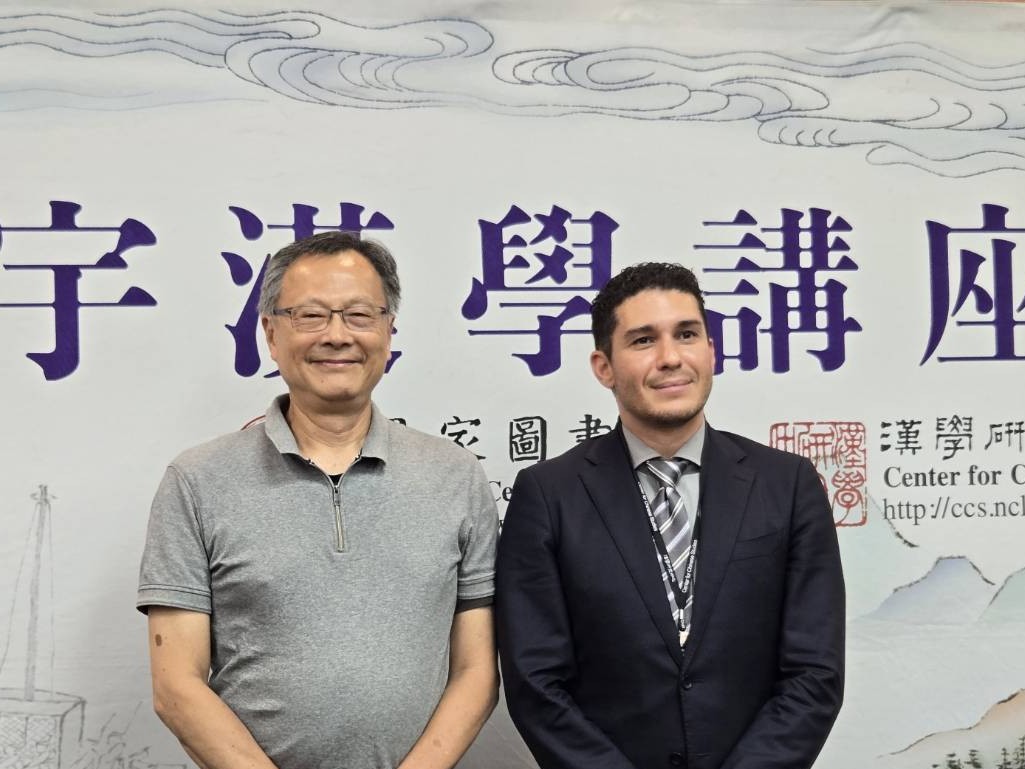
照片說明:(左起):余舜德研究員、喬耐斯博士
系統號:
CCS-102258
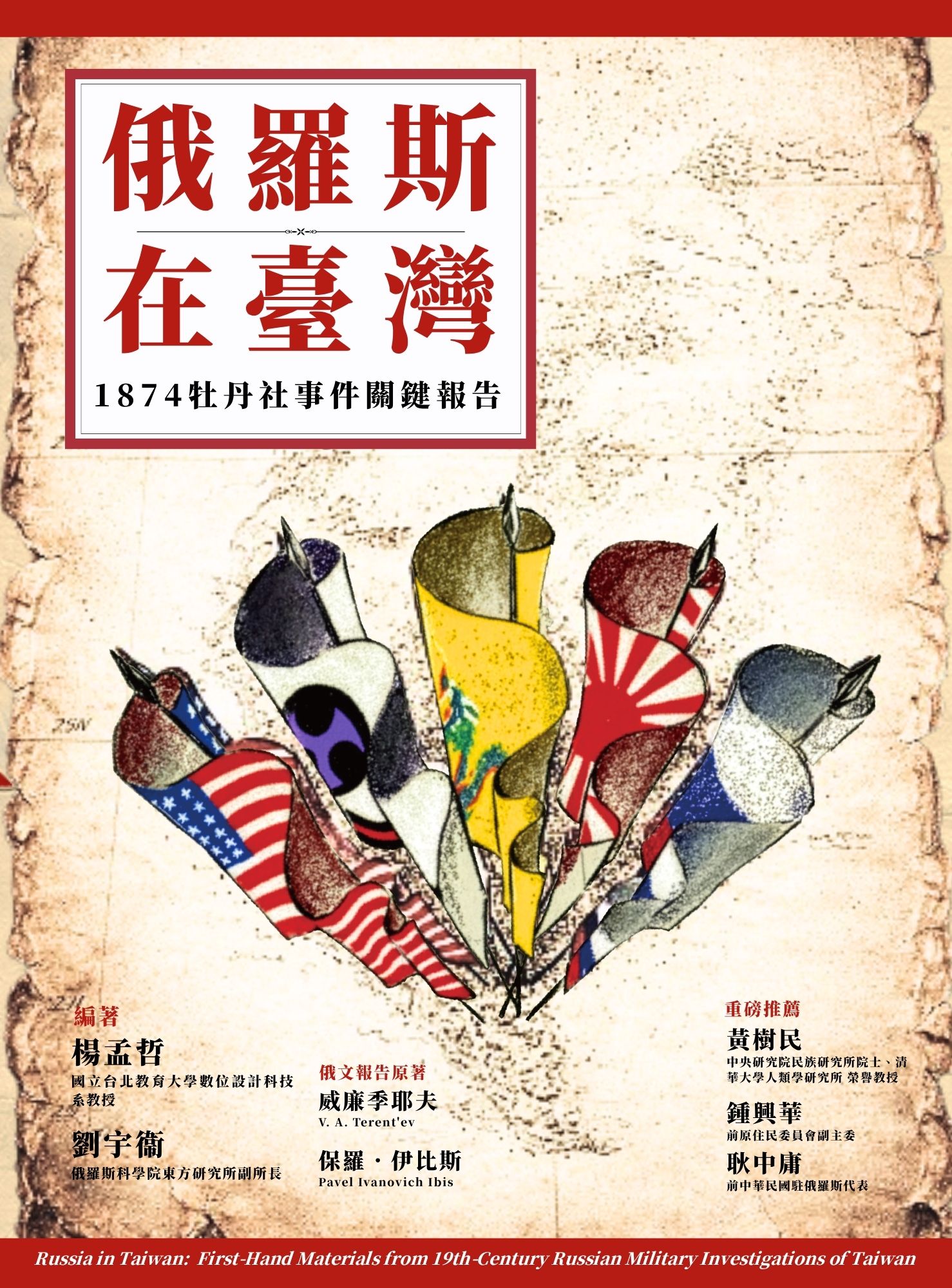
漢學研究中心2008年度獎助訪問學人劉宇衛教授合編之新書發表
標題:
漢學研究中心2008年度獎助訪問學人劉宇衛教授合編之新書發表
作者:
Dafydd Fell and Wang Hsiang
內容簡介:
漢學研究中心2008年度獎助訪問學人劉宇衛(Valentin Golovachev,俄羅斯科學院東方研究所副所長)合編《俄羅斯在臺灣:1874牡丹社事件關鍵報告》於今年6月由晨星出版。
系統號:
CCS-102195
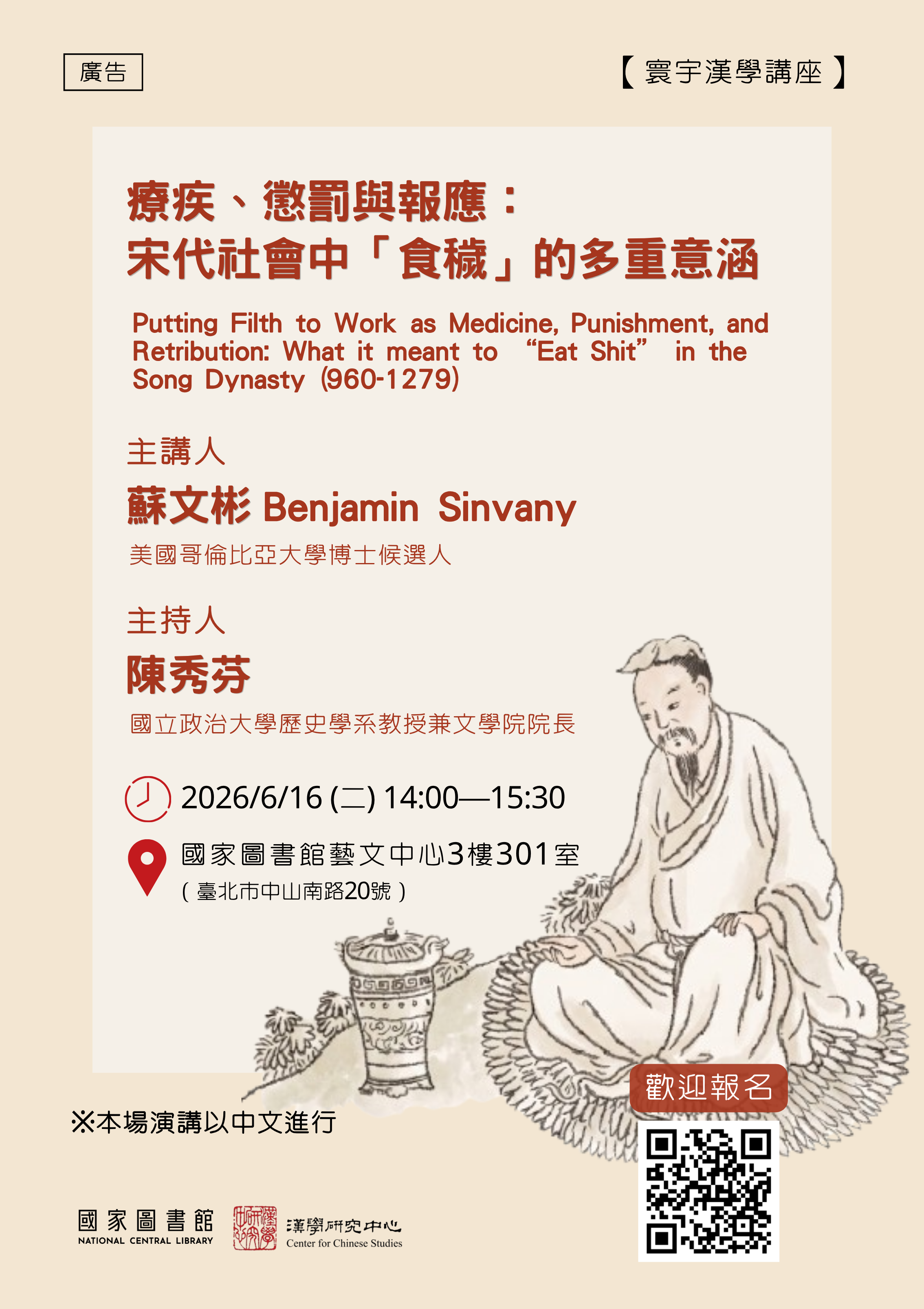
寰宇漢學講座邀請蘇文彬先生演講
標題:
時間:
2026年6月16日(週二)14:00-15:30
主講人:
蘇文彬(Benjamin Sinvany,美國哥倫比亞大學歷史系博士候選人)
地點:
國家圖書館藝文中心3樓301室(臺北市中山南路20號)
主辦單位:
國家圖書館、漢學研究中心
內容簡介:
講題:療疾、懲罰與報應:宋代社會中「食穢」的多重意涵(Putting Filth to Work as Medicine, Punishment, and Retribution: What it meant to “Eat Shit” in the Song Dynasty (960-1279))
主持人:陳秀芬(國立政治大學歷史學系教授兼文學院院長)
演講摘要:
本場演講將探討宋代食用穢物的現象。這種行為在歷史文獻中常被稱為「食糞」或「食穢」,演講中將展示人們實際吞食糞便的相關記載。本研究引用了豐富的宋代文獻,包含筆記、志怪小說、醫方典籍,以及保存在類書中的歷史軼事。將這些史料交織起來,展現了一幅關於極端行為的多元圖景。在某些案例中,人們主動要求食用糞便;有些則是違背意願被迫吞食;還有些情況下,糞便被當作公認的解毒劑來服用。在宋代,人們食用人類排泄物的原因似乎至少可歸納為三種:受人脅迫、遭受報應(天譴)以及醫療用途。本次演講所呈現的案例,揭示了宋代社會中一種獨特的「潔淨觀」(logic of purity)。在這種觀念下,「食穢」 得以具備多重功能:它既是治病解毒的方法、一種具脅迫性的懲罰,也是遭受神明報應的具體表徵。
This talk is about the consumption of filth in the Song dynasty. Sometimes referred to as “eating shit” (食糞) or “eating filth” (食穢) this talk presents accounts of people literally eating feces. It uses a wide selection of Song sources including biji, records of the strange 志怪, medical prescription texts, as well as historical anecdotes preserved in leishu 類書. Taken together, these excerpts form a diverse mosaic of extreme behaviors. In some cases, people demand to eat feces, in others they are forced to consume it against their will, and in others it is administered as a known antidote to poisoning. There appear to be at least three different reasons people consumed human excrement in Song China: coercion, divine retribution, and medicine. The cases presented here reveal a logic of purity in the Song that allowed eating filth to function as a method for healing (an antidote to poison), a coercive punishment, and a symptom of divine retribution.
主講人簡介:
蘇文彬 (Benjamin AK Sinvany) 是哥倫比亞大學歷史系與東亞研究系的博士候選人,主要研究中國宋代 (960–1279) 的社會史。廣義而言,他的研究興趣涵蓋科技、知識傳遞,以及社會對「廢棄物」與「厭惡感」的建構。蘇文彬運用非傳統史料,如筆記小說與志怪小說,並結合技術手冊,來探討歷史上的社會變遷。在早期的研究中,蘇文彬提出:在十二和十三世紀的東亞,不同國家對硝石(potassium nitrate or saltpeter)和硫磺等關鍵資源的獲取,是推動火藥發明的主要驅動力。目前他的博士論文暫名為《化廢為用:宋代中國 (960-1279) 的糞便與知識》(Putting Waste to Work: Feces and Knowledge in Song (960-1279) China)。西元 900 至 1300 年間的中國經歷了史無前例的人口增長,新技術層出不窮,且社會高度商品化。透過記錄這段時期人們對人類糞便的使用與看法,為了解自然界實用知識的累積與傳遞,提供了一個獨特的視角。該計畫拓展了科學史中傳統的比較問題(例如:東亞是否與歐洲一樣,利用人畜糞尿來製造硝石?),將人類糞便歷史化,視其為一種既有用又令人厭惡、既強大又危險的物質。蘇文彬的論文計畫反映了他熱衷於運用社會史與文化史的研究方法,來解答中國研究與知識史交匯處的諸多問題。
在進入哥倫比亞大學之前,蘇文彬取得了埃默里大學(Emory University 亞特蘭大,2015 年)的學士學位,以及約翰·霍普金斯大學與南京大學(Johns Hopkins and Nanjing University 南京,2020 年)的碩士學位。他出生於美國俄亥俄州。在學術研究之外,他經常參加「接觸即興」(Contact Improvisation) 的工作坊與交流活動,也會參加滑水 (Waterski+Wakeboard) 比賽。
Benjamin is a History-East Asia Ph.D. candidate at Columbia University researching the social history of Song (960-1279) China. Broadly defined, his interests include technology, knowledge transmission, and social constructions of waste and disgust. Benjamin uses non-traditional sources like collections of ghost tales and other strange stories alongside technical manuals to investigate historical social change. In earlier work, Benjamin argues that access to key resources like nitrogen salts (saltpeter) and sulfur by multiple states in twelfth- and thirteenth-century East Asia was a primary driver of the invention of explosives (e.g., gunpowder). His current dissertation project, tentatively titled “Putting Waste to Work: Feces and Knowledge in Song (960-1279) China” broadens traditional comparative questions in the history of science (e.g., was saltpeter was made from human and animal excrement and urine in East Asia as it was in Europe?) to historicize human feces as something both useful and repugnant, powerful and dangerous. Documenting the uses and views of human feces in China from 900-1300 AD – a moment of unprecedented population growth, and abundance of new technologies, and a highly commodified society – provides a unique perspective on the accumulation and transmission of practical knowledge about the natural world. Benajmin’s dissertation project reflects his interest in mobilizing social and cultural historical methods to answer questions at the intersection of Chinese studies and histories of knowledge.
Before arriving at Columbia, Benjamin completed a BA at Emory University (Atlanta, '15) and an MA (International Studies) at Johns Hopkins University and Nanjing University (Nanjing, '20). He was born in Columbus, Ohio. He regularly joins Contact Improvisation workshops and jams. Occasionally, he competes in Waterski and Wakeboard competitions.
備註:本場演講以中文進行
※以上會議時間如有變動,本中心將依報名資料另行通知
系統號:
CCS-102234
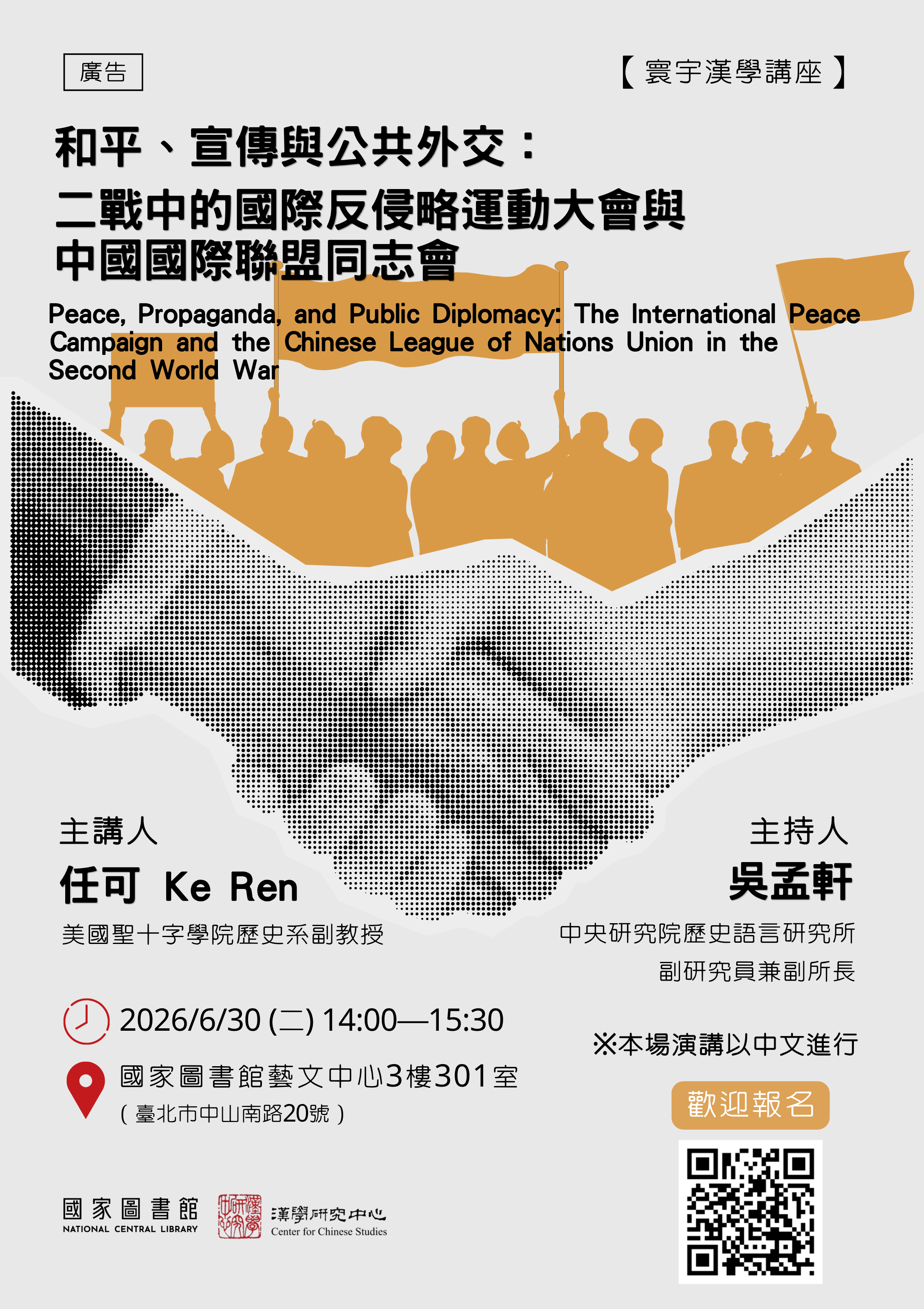
寰宇漢學講座邀請任可教授演講
標題:
時間:
2026年6月30日(週二)14:00-15:30
主講人:
任可(Ke Ren,美國聖十字學院歷史系副教授)
地點:
國家圖書館藝文中心3樓301室(臺北市中山南路20號)
主辦單位:
國家圖書館、漢學研究中心
內容簡介:
講題:和平、宣傳與公共外交:二戰中的國際反侵略運動大會與中國國際聯盟同志會(Peace, Propaganda, and Public Diplomacy: The International Peace Campaign and the Chinese League of Nations Union in the Second World War)
主持人:吳孟軒(中央研究院歷史語言研究所副研究員兼副所長)
演講摘要:
二戰在東亞的爆發和歐洲法西斯主義的興起,對中國和西方的國際主義者而言,既是危機也是挑戰。在1930年代至1940年代,中國和外國活動家致力於將中國納入各種跨國和平與反法西斯運動組織中。本次演講將聚焦於兩個重要的非政府或半官方組織:國際反侵略運動大會及其中國分會與中國國際聯盟同志會。這兩個組織都試圖將中國對日本侵略的抵抗置於捍衛世界和平與集體安全運動的核心。自1936年起,中國代表參加了多次由國際反侵略大會在歐洲主辦的國際和平會議,反侵略運動大會中國分會也發展為擁有十幾個省市分會和超過一百萬名會員的組織。而成立於第一次世界大戰末的中國國際聯盟同志會此時重組,成為國際主義和集體安全的主要倡導者,在中國國内宣傳國際聯盟,並通過發表雙語刊物、接待外國訪客以及積極參與國際活動,向國際社會闡釋東亞戰時政治局勢。
本次演講基於中國、臺灣、歐洲和美國的檔案資料,以及會議記錄和戰時書報期刊,探討二戰期間的國際反侵略運動大會及國際聯盟同志會怎樣在國家政府層面的互動之外,在中國國內宣傳國際主義並在國際舞台上為中國開展公共外交。這兩個組織的活動和出版物重新定義了和平與國際主義的意義,對二戰後的中國和臺灣也產生了一定的影響。
The outbreak of World War II in East Asia and the rise of fascism in Europe presented both a crisis and challenge to internationalists in China and the West. Throughout the 1930s-1940s, Chinese and international activists sought to incorporate China into a variety of transnational peace and anti-fascist movements or international organizations. This talk focuses on two key non-governmental or semi-official organizations – the International Peace Campaign (IPC) and its China national branch as well as the Chinese League of Nations Union (CLNU). Both groups sought to place China’s confrontation against Japanese aggression at the center of the movement to defend world peace and collective security. Beginning in 1936, Chinese delegates participated in several of the IPC- sponsored international peace conferences in Europe. At the same time, a National Branch of the IPC was established and eventually included over a dozen provincial and municipal committees and more than one million affiliate members. Simultaneously, the CLNU, originally established at the end of WWI, reorganized itself to become a leading advocate of liberal internationalism and collective security which promoted the League of Nations within China and elucidated political affairs in East Asia for an international audience through bilingual publications, hosting foreign visitors, and active participation in international societies.
Based on archival materials in China, Taiwan, Europe and the United States as well as conference proceedings and contemporary newspapers and periodicals, this talk argues that beyond state-level interactions, the IPC and the CLNU played an important role promoting internationalism in China while performing public diplomacy for China on the world stage during the Second World War. At the same time, their activities and publications reframed the meaning of peace and internationalism, with ramifications for both China and Taiwan in the post-WWII world.
備註:本場演講以中文進行
※以上會議時間如有變動,本中心將依報名資料另行通知
系統號:
CCS-102233
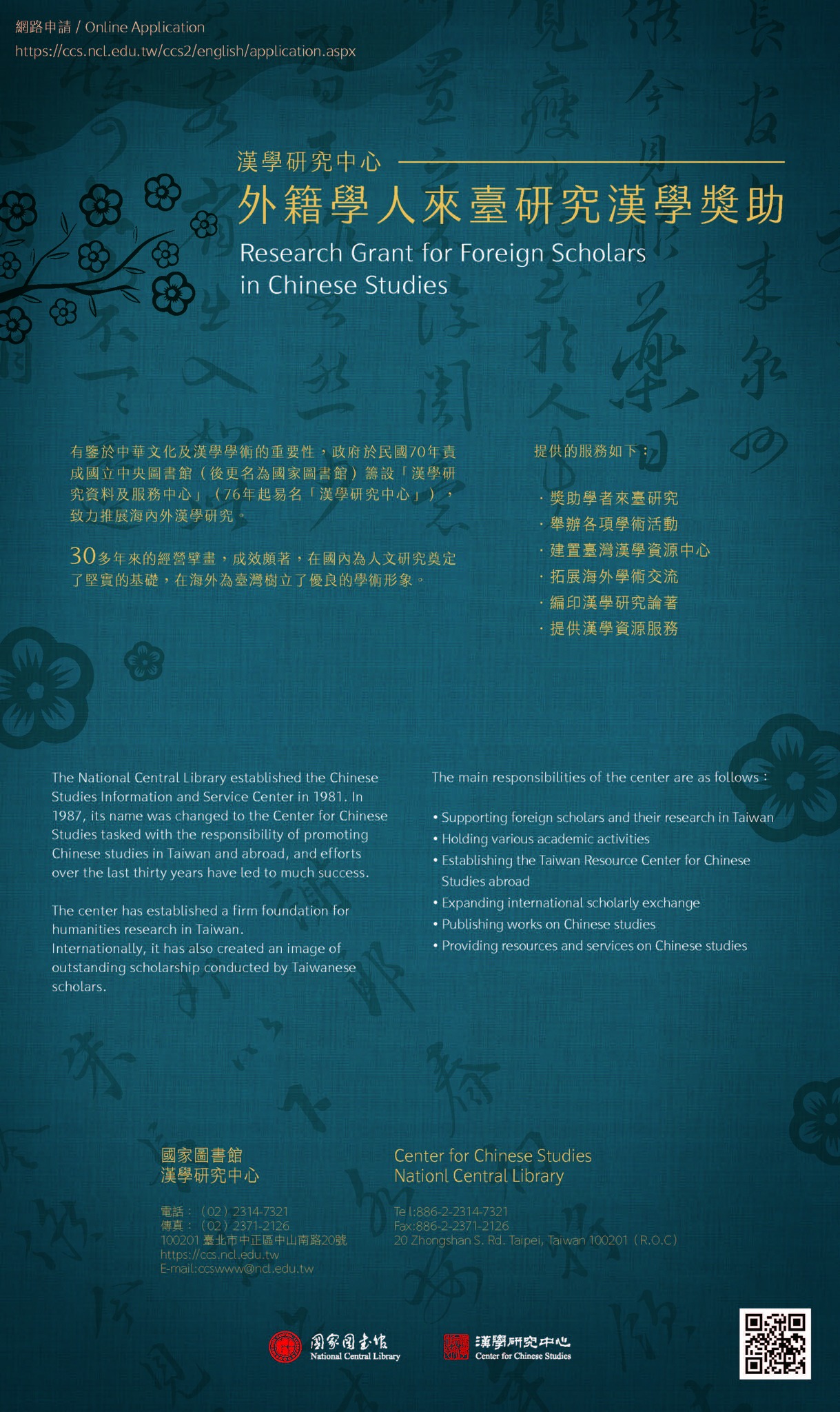
漢學研究中心2027年來臺外籍學人獎助申請公告
標題:
時間:
2026年5月31日、6月30日截止
地點:
國家圖書館(臺北市中正區中山南路20號)
內容簡介:
漢學研究中心負責管理兩項研究獎助計畫:「外籍學人來臺研究漢學獎助」及「外交部臺灣獎助金」。
「外籍學人來臺研究漢學獎助」2027年度的申請截止日期為2026年5月31日,所有申請資料皆須於此日期前以電子郵件或航空郵件寄達。甄選委員會的審查結果預計將於八月底前通知所有申請人。外交部委託本館漢學研究中心執行之「臺灣獎助金」2027年度申請期間為2026年5月1日至6月30日。
更多資訊及線上申請,請參閱以下網站:
外籍學人來臺研究漢學獎助: https://ccs.ncl.edu.tw/ccs2/ENGLISH/information.aspx
外交部臺灣獎助金: https://taiwanfellowship.ncl.edu.tw
符合資格的學者可同時申請兩項獎助金,若您對上述獎助計畫或漢學研究中心有任何疑問,歡迎與我們聯繫,電子郵件信箱為 ccsgrant@ncl.edu.tw 或 twfellowship@ncl.edu.tw
=============================================================================
Dear colleagues,
We are pleased to announce the call for applications for the 2027 Research Grant for Foreign Scholars in Chinese Studies (外籍學人來臺研究漢學獎助) administered by the Center for Chinese Studies (CCS, 漢學研究中心) at the National Central Library (NCL, 國家圖書館) in Taipei, Taiwan (R.O.C.). We would appreciate your assistance in disseminating this information.
The Center for Chinese Studies administers two research grants: the Research Grant for Foreign Scholars in Chinese Studies and the MOFA Taiwan Fellowship (外交部臺灣獎助金).
Applications for the 2027 Research Grant for Foreign Scholars in Chinese Studies are currently being accepted, with a deadline of May 31, 2026. All application materials for the Research Grant must be submitted electronically or by air mail no later than this date. Notification of the Selection Committee's decisions will be sent by the end of August. Applications for the 2027 Taiwan Fellowship, which CCS administers on behalf of the Ministry of Foreign Affairs, Taiwan (R.O.C.), will be accepted from May 1 to June 30, 2026.
Please visit our websites for more detailed information and online application:
Research Grant for Foreign Scholars in Chinese Studies: https://ccs.ncl.edu.tw/ccs2/ENGLISH/information.aspx
Taiwan Fellowship: https://taiwanfellowship.ncl.edu.tw
Scholars are encouraged to apply for both scholarships if eligible. Should you have any questions concerning either grant or the Center for Chinese Studies, please feel free to contact us via email at ccsgrant@ncl.edu.tw or twfellowship@ncl.edu.tw.
Sincerely yours,
Center for Chinese, Taiwan
National Central Library, Taiwan (R.O.C.)
系統號:
CCS-102165
